
Under the title "Transformation. Music Mediation as a Game Changer", the Anton Bruckner University in Linz hosted a conference from February 28 to March 1, 2025, which brought together the current discourse on music mediation as a socially relevant practice and opened up forward-looking perspectives. Within this framework, the Netzwerk Junge Ohren (NJO) designed an interactive workshop format in the form of a game. The guiding question posed by the conference was: How can music mediation initiate and help shape change in the music sector in the face of social challenges? The cooperative approach of "Escape Music Mediation" gave participants the opportunity to explore specific challenges in the music world in a collaborative and solution-oriented manner and to reflect on their own potential for transformation.
Unter dem Titel „Transformation. Music Mediation as a Game Changer“ veranstaltete die Anton Bruckner Privatuniversität Linz vom 28. Februar bis 1. März 2025 eine Tagung, die den aktuellen Diskurs über Musikvermittlung als gesellschaftlich relevante Praxis bündelte und zukunftsweisende Perspektiven eröffnete. Im Rahmen der Tagung entwickelte das Netzwerk Junge Ohren (NJO) ein interaktives Workshopformat in Form eines Spiels. Ausgangspunkt war die Leitfrage der Konferenz: Wie kann Musikvermittlung angesichts gesellschaftlicher Herausforderungen Wandel im Musiksektor anstoßen und mitgestalten? Der kooperative Ansatz von Escape Music Mediation ermöglichte es den Teilnehmenden, konkrete Herausforderungen der Musikwelt gemeinschaftlich und lösungsorientiert zu bearbeiten sowie das eigene Transformationspotenzial zu reflektieren.
L’université Anton Bruckner accueillait entre le 28 février et le 1er Mars une conférence intitulée « Transformation. Music Mediation as a Game Changer ». Celle-ci permettait de faire la synthèse des discussions actuelles présentant la médiation comme une pratique socialement pertinente et ouvrait sur de nouvelles perspectives. Dans ce cadre, le réseau « jeuns oreilles » (Netzwerk Junge Ohren - NJO) a conçu un atelier interactif sous la forme d’un jeu de table. La question principale posée durant cette activité était : Comment la médiation de la musique peut-elle initier et aider à façonner des changements dans un secteur musical qui fait face à des défis d’ordre sociaux. L’approche coopérative d’ « Escape Music Mediation » offrait aux participant·es l’opportunité d’explorer les challenges spécifiques rencontrés par les mondes musicaux dans une perspective collaborative et orientée sur les solutions mais aussi de réfléchir à leur propre potentiel de transformation.
game, transformation, music mediation
The development of Escape Music Mediation, a game-based setup to explore the transformative power of music mediation, is grounded in the conviction that this field indeed holds the potential to initiate and accompany processes of change. After almost 20 years of networking in German-speaking countries, this is undisputed for the Netzwerk Junge Ohren (NJO). Music mediation as a field of practice goes far beyond what was still understood in the early 2000s as developing the audience of tomorrow, which mostly meant introducing young people to an existing musical canon and accustoming them to its rituals. When we talk about music mediation today, we refer to creating sustainable relationships and establishing closeness between people and music, between audiences and institutions, between artistic practice and social negotiation processes. Music mediation asks who is being reached and who remains invisible or unheard. It reflects on how programs, formats, and working methods shape notions of "good life" and the "future", and how institutions position themselves with regard to participation and inclusion. In doing so, it marks an attitude that goes far beyond specialized job profiles.
Music mediation is – without going into the term itself in more detail here – an interdisciplinary field that clearly transcends the artistic sphere. It operates at the margins of institutions, between art and society, across disciplines and professional fields. As a result, it is adept at connecting systems while critically examining them, and can function as a catalyst for social and institutional change. Our society is undergoing fundamental change, marked by a growing heterogeneity of living conditions. Sociologist Aladin El-Mafalani uses the term "superdiversity" (2024, p. 77) to describe this complexity. Cultural institutions are challenged to rethink their positioning in the social context and develop strategies for opening themselves up to an increasingly diverse society and becoming relevant to different realities of life.
What contribution do cultural institutions and their offerings make to strengthening meaning and cohesion in society, and how do they answer to the question: How do we want to live? This is about far more than merely (re)structuring music-related programs; it concerns transformative processes that reach deep into the DNA of an institution. As Carsten Brosda analyzes: "Anyone who resolutely opens an opera house [...] to society as a whole hopes to change not only individuals in the audience, but also the institution itself" (2020, p. 128).
Music mediation therefore has the potential to bring about and accompany change. But what is the real transformative power of music mediation? A look at the field reveals an ambivalent picture. In a 2025 survey conducted by the NJO, respondents attributed high relevance to their work in addressing the future challenges of the music industry. On the other hand, many feel that their scope for action is limited and their role marginalized. Poor pay, high workloads, a lack of structural anchoring, and low appreciation mean that a significant proportion of these mostly highly qualified professionals want to leave the field in the future (von Nell, 2025).
This shows that music mediators are aware of the value of their expertise for shaping the future of musical life. However, beyond their own profession, this potential is often not recognized or remains limited to the specific range of tasks involved in mediation in the narrower sense. Given the limited effectiveness and sustainability of their work, a significant proportion of respondents conclude that they want to leave the system and seek other career prospects for themselves. This is an alarming signal for the music sector. The already high staff turnover in the field threatens to rise further– with serious consequences in light of demographic change and the looming shortage of skilled professionals. Alexander von Nell succintly summarizes the findings of the NJO survey: music mediation must be recognized not only in contact with the audience, but also in institutional transformation processes. He calls for a new understanding of organizational roles – and the serious, structural integration of music mediation at the institutional level (von Nell, 2025).
Music mediation often remains “under the radar”, in part because mediation activities are still frequently not coherently integrated into the overarching narrative of institutions. One reason for this is that those who design mediation projects rarely stay long enough at the institution to penetrate structures and contribute to organizational knowledge in the long term. Examples such as the Deutsche Kammerphilharmonie Bremen, the Elbphilharmonie, and the Beethovenfest Bonn show that there is another approach: here the mediation team is involved at management level and also participates in strategic decisions.
The game Escape Music Mediation, developed by the NJO for the workshop in Linz, does not view music mediation as a limited field of practice, but as a lense through which the entire organizational context of a cultural institution can be viewed.
The game is played in several teams of up to six people. Each group represents a fictional cultural institution whose future must be secured. Within the institution, different perspectives and interests clash and must be constructively negotiated over the course of the game.
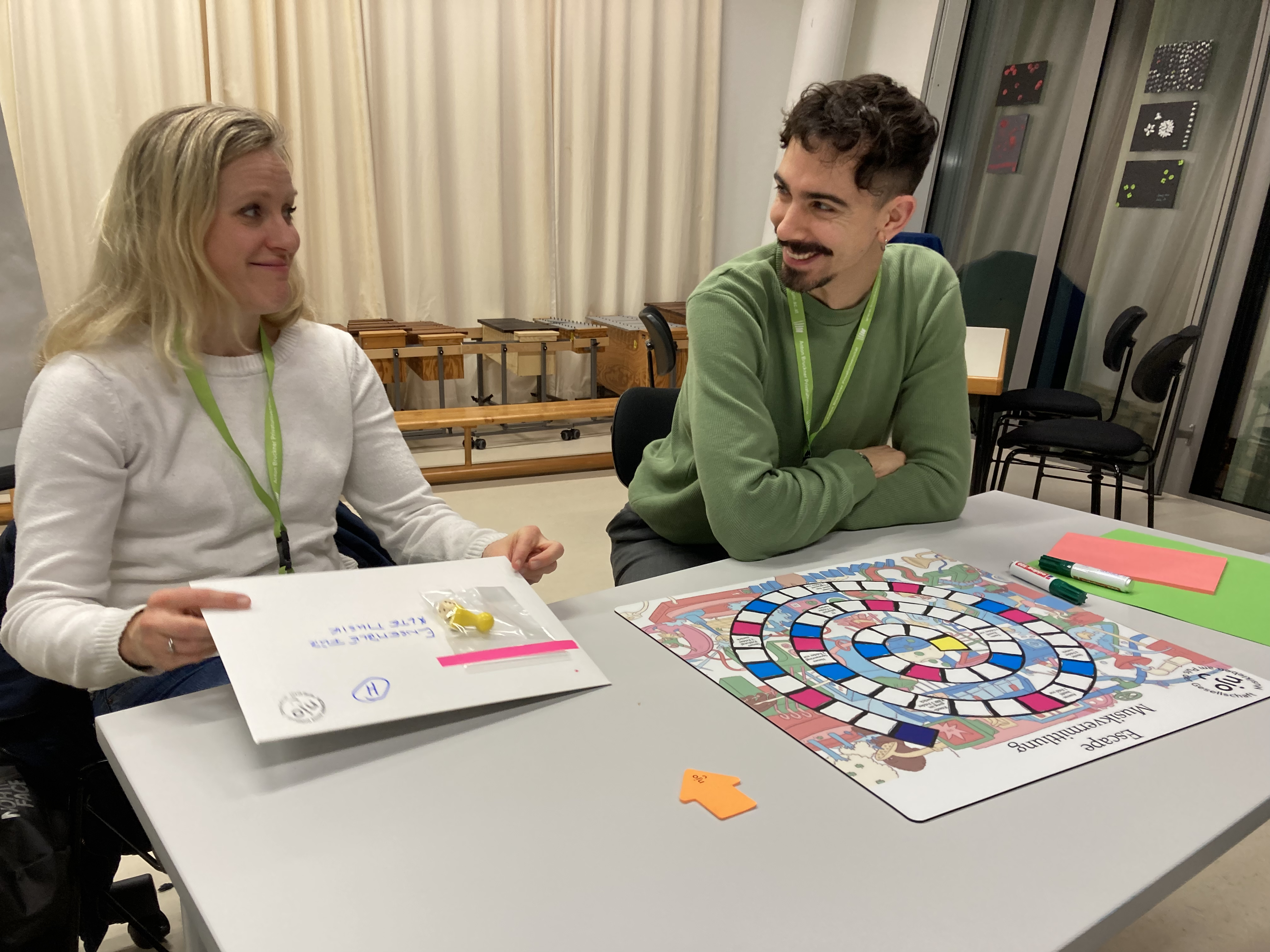
Using an introductory scenario, each team familiarizes itself with its institution. This could be, for example, a municipal theater with significant internal tensions, which are expressed in three distinct attitudes: one that is progressive in terms of content, one that is conservative and excellence-oriented, and one that is economically and capacity-oriented. The perspectives are not tied to specific functions or individuals, but rather mark power relations as they are found in many institutions. Various scenarios are available that can be played out in parallel within the framework of a workshop.
On a classic game board with pieces and dice, the groups navigate through various event fields that reflect possible challenges in the cultural sector: from technical glitches and political controversies to strategic decisions in program design or communication. For each task, the group is given a limited amount of time to agree on how their institution will act under the given conditions, which values are reflected in their decisions, how different positions can be discussed, and which solution strategies can be developed. Instead of individual role-playing positions, the focus is on joint thinking and deliberation. Escape Music Mediation is a cooperative game arrangement, not a competition, but an experiment in collective action.
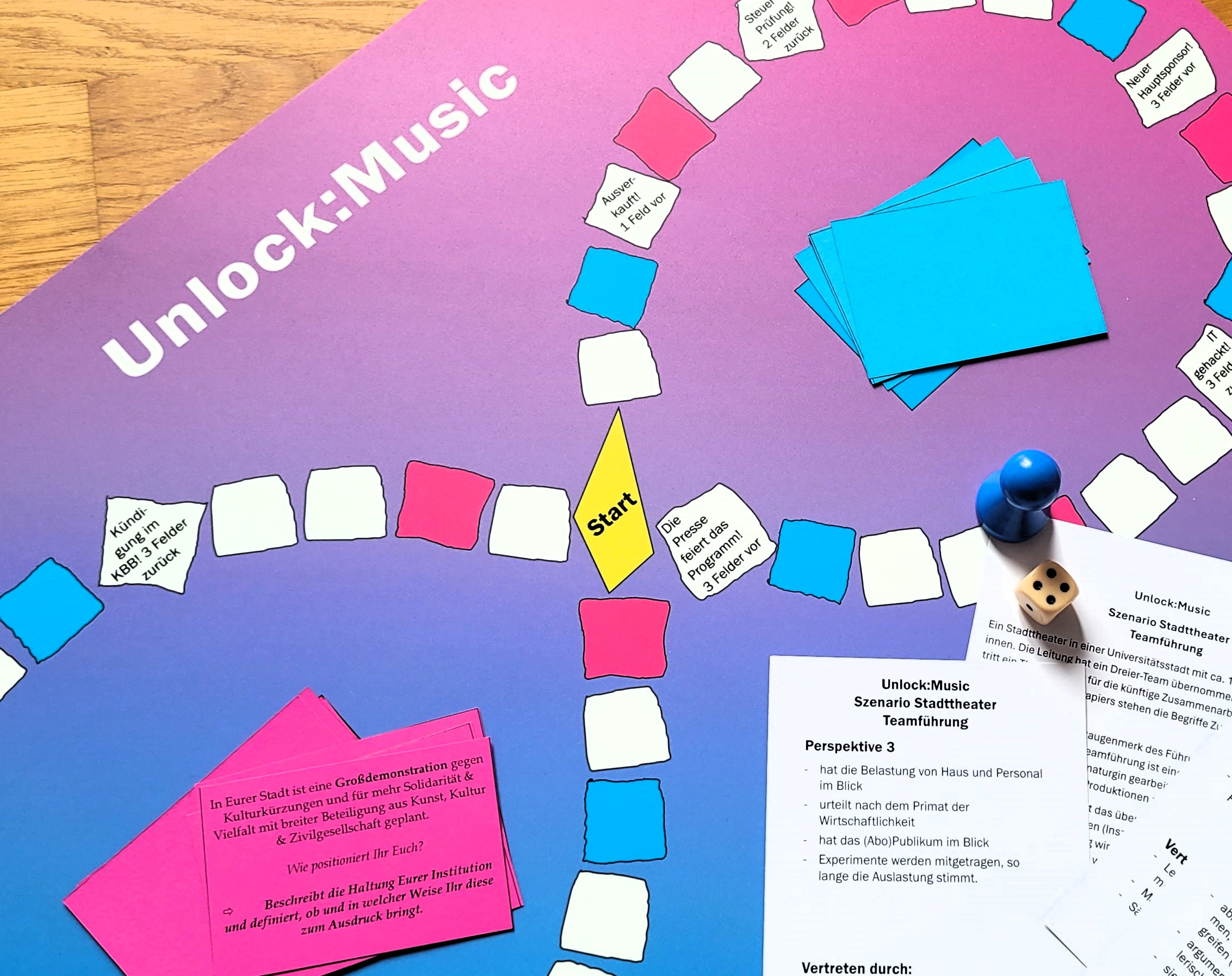
Additional momentum is generated by interventions form the game masters. If, for example, a new funding program is announced that can only be applied for in cooperation with another institution, the teams must decide: Do they risk interrupting the flow of the game for a collaboration whose success is not guaranteed or do they play it safe and prefer to continue on their own course? How do they convince their fellow players in order to win the funding together? Behind this lies the conviction that future challenges in the cultural sector can increasingly no longer be addressed in isolation; instead, it is essential to seek and practice collaboration across institutional and professional boundaries.
At the end, the groups present and reflect on their solutions in a joint plenary session. There are no clear-cut answers; instead, transformation is experienced as an open process in which ambivalence, conflict, and dissent are understood not as disruptions but as productive forces. The evaluation shows time and again that even under identical starting conditions, completely different paths and results emerge.
Change requires permeability. Cultural manager and politician Adrienne Goehler speaks of "liquefaction" (2006, p. 16), through which solidified structures are set in motion. Stagnation can only be broken through dialogue and "trying out new and different things" (Goehler, 2006, p.16). This is exactly what Escape Music Mediation invites you to do by providing a safe space to venture away from familiar paths. The classical music sector is focused on perfection and smooth operation. Spaces for experimentation, where failure is allowed and understood as an opportunity, are rare. When playing, we can take this space and engage in what Norbert Trawöger describes as "a process of encouragement, of trying things out as a matter of course" (2021, p. 23).
Since its premiere in Linz, the game has been further developed and used in various contexts, for example in consulting workshops or, most recently, under its new name unlock:music at the tuned Ideenfestival on the Future of Classical Music organized by the German Federal Cultural Foundation (November 2025 in Bochum). In Linz, the groups were still relatively homogenous, as all participants came from music medation backgrounds. Nevertheless, the given scenario succeeded in initiating roles and the players practiced formulating their own arguments convincingly in new contexts. A similar effect was seen in a workshop with a transcultural ensemble. Although an individual scenario was provided, the group deliberatley chose to take on the roles of other institutions such as concert halls or festivals. The feedback indicated that looking through the perspective of another organization offered new insights, for example, which criteria shape decisions or how one's own topics can be effectively integrated into different contexts.

The game helps participants to view decision-making processes not only from a perspective of mediation. It widens the view, sharpens argumentative skills, and shows how substantive concerns can be translated into the logic of organizations. Especially when groups are composed heterogeneously, a space for genuine encounter emerges. Roles and hierarchies dissolve, exchange on equal footing becomes possible, and change can be explored in a playful and meaningful way.
The title Escape Music Mediation is apt in that the game helps to free music mediation from its constraints, which repeatedly tie it to limited notions of mediation work. This occurs in two ways: on the one hand, music mediators consciously rethink their role and influence within the game. On the other hand, through the playful encounter of different professions and disciplines, music mediation is naturally and literally present at the table.
Escape Music Mediation opens up possibilities that go beyond the workshop itself. Scenarios, perspectives, and tasks can be adapted for specific institutions on request and integrated into consulting processes, so that real key figures, areas of tension, and conflicting goals can be incorporated into the development of the game. In this way, it becomes a flexible tool for institutional learning processes. Feedback from previous sessions has been consistently positive.
The future-oriented topics addressed in the game have the potential to spark challenging discussions that would usually remain unresolved in pure conversation and leave all participants with concerns and discomfort. We are all familiar with this effect from meetings and conferences: topics are often so complex, abstract, and challenging that it is difficult to know where to begin and what one can accomplish as an individual. The chosen setting prevents this, instead creating a sense of ease: after all, a game is neither serious nor binding. This encourages participants to take initiative, take risks, and perhaps design something that has never existed before. This is liberating, fosters a sense of agency, and makes the process enjoyable.
American game designer, author, and computer game researcher Jane McGonigal considers game design methods that encourage players to tackle difficult challenges in different constellations to be a groundbreaking way of thinking and leading for the 21st century: "Antoine de Saint-Exupéry once wrote: The future should not be predicted, but made possible. Games will be one of the most important platforms in the 21st century for making our future possible" (McGonigal, 2021, p. 24). Playground designer Yinka Ilori sums it up succinctly in an interview with ZEIT magazine: "Playing is problem solving" (Apel, 2024, p. 84).
Against this backdrop, it is not surprising that others are also "playing" with questions about the future and tackling challenges for their organizations with game methods. The examples vary from prototypical versions for internal use to finished games that are available for purchase. For its team day, the Schleswig-Holstein Kompetenzzentrum Musikalische Bildung (KMB.SH) developed a game to deepen knowledge about joint projects and strengthen cohesion within the association. At the Liechtenstein Music Academy, Beat Fehlmann uses a strategy game based on the principle of Eile mit Weile (a board game similar to Ludo) to bring topics such as resilience, motivation, and interpersonal skills to life, encouraging reflection on how training prepares artists for life in a holistic sense. The Swiss Cultural Mediation Association distributes the Parcours P card set and an online version as a game-based planning tool to support participatory cultural projects and improve exchange between practice, promotion, and cultural policy.
It is our conviction that in the real practice of musical life, we cannot know which solutions will be successful in the future. There are many factors that we cannot yet know, and especially in view of the great challenges currently facing culture and society, we do not need ready-made recipes, but rather the courage to break new ground, openness to unusual solutions, and the willingness to learn from mistakes. We understand transformation as a process that can never be fully completed.
Games are a way to engage with open-ended processes and future challenges or at least to begin doing so. They offer an invitation to exercise our "muscles of possibility" (Trawöger, 2021, p. 14) helping those accustomed and willing to play remain capable of acting when it really matters.
Apel, A. (2024, April 10). Stadtgestaltung. „Farbe kann uns retten!“. ZEITmagazin. Retrieved May 15, 2026 from https://amelieapel.com/2024/04/10/zeitmagazin-farbe-kann-uns-retten/
Brosda, C. (2020). Die Kunst der Demokratie. Hoffmann & Campe.
El-Mafalani, A., Kurtenbach, S., & Strohmeier, K.P. (2024). Kinder. Minderheit ohne Schutz, Kiepenheuer & Witsch.
Goehler, A. (2006). Verflüssigungen. Campus.
McGonigal, J. (2012). Besser als die Wirklichkeit! Warum wir von Computerspielen profitieren und wie sie die Welt verändern. Heyne.
Trawöger, N. (2021). Spiel. Kremayr & Scheriau.
von Nell, A. (2025, May 5). Hochqualifiziert & auf dem Sprung zu neuen Aufgaben. Umfrageergebnisse „Arbeitsbedingungen Musikvermittlung 2025". Best of #12. Retrieved June 16, 2026 from https://www.jungeohren.de/umfrageergebnisse-arbeitsbedingungen-musikvermittlung-2025/
Katharina von Radowitz studied social pedagogy in Bochum and philosophy and cultural studies at the University of Witten/Herdecke. Until the end of 2025, she was managing director of Netzwerk Junge Ohren (NJO), which she helped to establish in 2007. As a consultant, she supports project development and strategy processes. www.unlock-music.de
The automated analysis of the work in order to obtain information, particularly concerning patterns, trends, and correlations as defined in § 44b (text and data mining) of the German Copyright Act (UrhG) is prohibited without the written consent of the rights holders.
ISSN 2943-6109 – Volume 3/1 (2026) – DOI: 10.71228/ijmm.2026.58
This paper is published under a Creative Commons Attribution NonCommercial 4.0 International License. Parts of an article may be published under a different license. If this is the case, these parts are clearly marked as such.
