
This article presents a theory-informed reflection on practice concerning transformation in higher music education by examining boundary-spanning music mediation practices in academic continuing education. It focuses on the Schleswig-Holstein Competence Centre for Music Education (KMB.SH) and the continuing education programme Music in Social Work/Community Music at the University of Music Lübeck (MHL). The analysis traces how music mediation supports ongoing translation between the professional logics of higher music education institutions, music education and social work, and how transformation processes become observable through this work. At the micro and meso levels, the article examines potentials for change, including shifts in professional role understandings and the negotiation of musical quality in socially situated music making. It argues that music mediation contributes to transformation as a practice embedded within a wider set of conditions and identifies limits in terms of reach, resources, and structural stability.
Dieser Artikel legt eine theoriegeleitete Praxisreflexion zu Transformationsprozessen in der tertiären musikalischen Bildung vor. Dafür untersucht er grenz- und schnittstellenübergreifende Praktiken der Musikvermittlung in der akademischen Weiterbildung. Im Mittelpunkt stehen das Kompetenzzentrum für musikalische Bildung Schleswig-Holstein (KMB.SH) und das Weiterbildungsprogramm Musik in der Sozialen Arbeit/Community Music an der Musikhochschule Lübeck (MHL). Die Analyse zeichnet nach, wie Musikvermittlung die fortlaufende Übersetzung zwischen den professionellen Logiken von Musikhochschulen, musikalischer Bildung und Sozialer Arbeit unterstützt und wie daran Transformationsprozesse nachvollziehbar werden. Auf der Mikro- und Mesoebene untersucht der Artikel Veränderungspotenziale, darunter Verschiebungen im Verständnis beruflicher Rollen und die Aushandlung musikalischer Qualität beim Musizieren in sozialen Kontexten. Der Beitrag zeigt, dass Musikvermittlung Transformation nicht allein hervorbringt, sondern als Praxis innerhalb eines größeren Zusammenhangs dazu beiträgt. Zugleich benennt er Grenzen hinsichtlich Reichweite, Ressourcen und struktureller Stabilität.
Cet article propose une réflexion sur la pratique, éclairée par la théorie, concernant les processus de transformation dans l’enseignement musical supérieur. À cette fin, il exa mine les pratiques de la médiation de la musique à l’interface de différents champs profes sionnels dans le cadre de la formation continue universitaire. Il se concentre sur le Centre de compétences pour l’éducation musicale du Schleswig-Holstein (KMB.SH) ainsi que sur le programme de formation continue Musique dans le travail social / Community Music de la Haute École de musique de Lübeck (MHL). L’analyse retrace la manière dont la médi ation de la musique favorise un travail continu de traduction entre les logiques professi onnelles propres aux établissements d’enseignement supérieur de musique, à l’éducation musicale et au travail social, et montre comment les processus de transformation devien nent observables à travers cette activité. Aux niveaux micro et méso, l’article examine les potentiels de transformation, notamment l’évolution des conceptions des rôles professi onnels ainsi que la négociation de la qualité musicale dans des pratiques musicales soci alement situées. Il montre que la médiation de la musique contribue à la transformation en tant que pratique inscrite dans un ensemble plus large de conditions institutionnelles et organisationnelles, tout en mettant en évidence ses limites en termes de portée, de res sources et de stabilité structurelle.
higher music education, academic continuing education, collaboration, quality, Third Mission
Higher Music Education Institutions (HMEIs) are under increasing pressure to reposition themselves in times of rapid societal change. This dynamic influences how they understand their public role and the framing of artistic practice and education. Gaunt et al. argue that a "paradigm shift" is needed in professional higher music education toward the understanding of "[T]he musician as a maker in society" (Gaunt et al., 2021, p. 16). This shift requires institutions to reflect on their societal mandate and to strengthen the connection between artistic practice and social responsibility.
Numerous institutions are increasingly orienting their work towards civic responsibility and community engagement (Gaunt et al., 2021, p. 2). In response to the resulting tensions, Gaunt et al. (2021, p. 4) draw on Schmidt Campbell’s idea of a "partnering of values" to argue that artistic and societal goals should be understood as mutually reinforcing rather than opposed. This is reflected not only in curricula changes, but also in how institutions begin to think about learning across the professional lifespan, with growing attention to alumni as well as learners beyond initial degree programmes (AEC, 2024). Such developments remain gradual, but they signal a widening understanding of institutional responsibility across different phases of professional life. They also reflect that changing conditions in society bring new demands at different career stages that initial degree studies cannot fully cover.
Situated within this debate, this contribution deliberately focuses on a specific institutional space within higher music education. The focus lies on an enabling framework for music education in Schleswig-Holstein (KMB.SH) and on academic continuing education at the University of Music Lübeck (MHL) without addressing degree programmes as a whole. Using the example of one specific continuing education programme, the text addresses the often-underestimated role of music mediation as a "key agent and architect of transformation" (Call for Papers IJMM, 2025). Music mediation is not approached here as an audience-facing practice. Instead, the focus lies on intra-music mediation (Müller-Brozović, 2023, p. 175) and on the ways in which music mediation work can transform those who design, implement, and sustain it, as well as the institutional settings in which it is embedded (Call for Papers IJMM, 2025). In this sense, music mediation is understood as a boundary-spanning practice that can initiate organisational learning and processes of change through translation and brokering between different professional fields and institutional logics.
In the understanding of this contribution, these change processes cannot be explained in a monocausal way. Music mediation is not presented here as a singular "game changer" (Call for Papers IJMM, 2025), but as a contributory practice within a logic of entanglement that helps to shape the conditions under which change becomes possible. Furthermore, it is analytically useful to understand transformation not as a plannable or linear development, but as an open-ended learning process (Call for Papers IJMM, 2025) that unfolds over time through iterations, reflection, and negotiation. Accordingly, this analysis traces how change emerges through ongoing communication and negotiation within specific institutional settings instead of following predefined stages. The guiding question is: What micro and meso level potentials for transformation in higher music education emerge from KMB.SH-enabled academic continuing education? This question is explored through the programme Music in Social Work/Community Music, where boundary-spanning music mediation practice becomes observable. The article therefore concentrates on selected developments at MHL and does not aim to provide a comprehensive account of all transformation processes.
In methodological terms, the approach is a retrospective reconstruction from within the institution, drawing on the author’s involvement as well as internal documents and programme materials. It traces how boundary-spanning music mediation practices unfold over time within an enabling structure.
The Centre for Music Education Schleswig-Holstein (Kompetenzzentrum für musikalische Bildung Schleswig-Holstein, KMB.SH) is a statewide publicly funded consortium for music education in Schleswig-Holstein, Germany. It was established in 2021 as a joint initiative of five partner institutions and works through a board, a core team, and an external advisory council. The current funding period runs until the end of 2026 with long-term continuation envisaged.
The constellation brings together higher music education, school-based education, extra-curricular music education, continuing education, and cultural policy coordination at eye level1. It links broad-based music education with excellence-oriented artistic training and professionalisation and functions as an enabling framework that organises cooperation across institutional boundaries (KMB.SH, n.d.). It provides a platform for exchange and joint development based on shared principles. Joint projects within the consortium can be supported with personnel and financial resources when at least two partners are involved. In the German context, this consortium is considered exceptional.
The KMB.SH enables change by stabilising cooperation as a lasting structural condition. Its work is guided by thematic priorities, including the development of sustainable continuing education structures, the strengthening of cultural participation, outreach, and music mediation, the support of professional pathways across the lifespan and the connectivity between educational sectors (KMB.SH, n.d.). This is supported by dedicated coordination capacity and regular joint working formats that foster alignment and shared orientation without imposing centralised control. Public funding makes this coordination capacity possible and allows continuity. This creates room to pilot new formats and, if successful, stabilise them over time. The KMB.SH also supports translation work between different institutional logics and quality criteria and thus contributes to transformation by shaping the conditions under which change in higher music education can unfold.
The University of Music Lübeck (MHL) was among the main drivers in establishing the consortium in 2021 and provides an institutional context in which new KMB.SH impulses can be taken up. This capacity is linked to how the MHL is organised. The interrelation of artistic, pedagogical and scholarly pillars through polyvalent study programmes has fostered cooperation across disciplinary and genre boundaries. Interdisciplinary work is therefore familiar within the institution, even though it has limits and can involve tensions between professional aims and expectations. Handling such tensions through negotiation and translation is part of the MHL’s everyday practice.
Against this background, the MHL could connect KMB.SH impulses to institutional routines. The consortium provided a framework and resources and the MHL provided continuity through an organisational home for academic continuing education. Since the start of the KMB.SH, a centre for artistic-scientific continuing education has been established, supported by a position that is designed for long-term continuity. Several continuing education programmes are running and further offers are in preparation (Musikhochschule Lübeck [MHL], n.d.). These developments do not indicate a MHL-wide transformation, but they show where impulses could be absorbed and embedded.
The following section outlines academic continuing education at the MHL and explains why this institutional space is analytically relevant for the present case.
For many musicians, professional biographies are shaped by portfolio careers and non-linear transitions. Artistic practice, pedagogical work, music mediation, and further fields are often combined with each other (Smilde, 2021). At the same time, both professional experience and research suggest that degree structures often reflect this reality only to a limited extent and that competence gaps can emerge as a result (Bishop, 2022). Consequently, academic continuing education gains importance within higher music education. It addresses learning needs that often become relevant once the career has started or in mid-career phases through concrete professional experience with role changes or phases of reorientation.
Despite this relevance, academic continuing education remains structurally marginal within German higher music education. Permanent and institutionally anchored structures are rare (Bosch & Ahner, 2025). Although higher education policy recommendations have identified academic continuing education as an important field of development for years (Wissenschaftsrat, 2019; Hochschulrektorenkonferenz, 2021), its implementation within music universities remains fragile. The case discussed here shows how academic continuing education can be structurally enabled and how this can foster change within a specific regional and institutional configuration.
At the MHL, academic continuing education functions as an institutional interface between higher music education, professional fields, and different life and career phases. In the KMB.SH context, this includes cooperation with regional partners who bring perspectives from different educational sectors and professional practices into shared formats. It connects artistic and pedagogical perspectives with music mediation approaches and practice-based knowledge brought in by participants from diverse professional contexts. This interface work involves ongoing translation and negotiation between different expectations, quality criteria, and professional logics. Heterogeneity plays a central role within this setting. Diverse educational and professional biographies create potential for peer learning and multiperspectival exchange (Peters & Ziegenmeyer, 2025).
Continuing education programmes at the MHL follow the Swiss certification model2 (Zimmermann, 2019) and provide the structural basis for this interface. The DAS in Elementary Music Education is one example, another is the CAS in Improvisation Pedagogy. The case discussed here is situated in the CAS Music in Social Work/Community Music. Further offers are currently being developed, including a CAS in Music Mediation that is designed to connect with existing programmes and lead to modular certification options.
Significance also lies in how programmes feed back into the MHL as continuing education can bring new perspectives into teaching and cause reflection on institutional routines. This is the context in which the boundary-spanning music mediation practices discussed later can unfold.
The continuing education programme Music in Social Work/Community Music brings together participants from social work and music education.
The programme is situated within a broad understanding of music mediation. Following Petri-Preis, Chaker, and Ziegenmeyer (2025), music mediation can be framed as a "broad artistic-educational practice implemented by individuals with diverse biographical, educational and professional backgrounds [which] deliberately seeks to establish various relationships between people and musics" (p. 15). In this sense, community music and music mediation are closely related practices with similar goals (Petri-Preis et al., 2025). The focus in this contribution is less on strict terminological distinction and more on how aims, roles and quality criteria are negotiated across contexts.
Transformation is understood as an open and unfinished learning process. It does not describe a movement from a fixed present state towards a defined target state, but ongoing reconfigurations of perspectives and professional self-understandings (Mohr, 2023). Such processes are often nonlinear and only become readable as coherent developments in retrospect. Moments in which previously separate strands became connected are referred to as nexus moments.
The focus of this contribution lies on intra-music mediation (Müller-Brozović, 2023, p. 175). It examines micro and meso level change that becomes visible in shifts in professional role understandings among those who design and facilitate practice-based formats as well as in the organisational contexts in which this work is embedded. The macro level is not analysed as a transformation level in its own right. It refers to the broader higher music education debates on paradigm shift, partnering of values (Gaunt et al., 2021), and Third Mission orientations, as well as to the funding conditions that shape what becomes possible.
As an analytical lens, the article draws on the idea of music mediation as boundary-spanning practice. Boundary spanning is understood here in a descriptive sense as interface work across professional and institutional contexts that operate according to different logics (Westerlund & Karttunen, 2025). It involves translation across contexts and enables joint development without full homogenisation. Such work relies on a shared stance through which differences are handled. This stance becomes visible in joint conceptual work, in music making itself and in recurring reflective routines.
The continuing education programme Music in Social Work/Community Music was launched in 2022 at the MHL within the KMB.SH framework. It was designed as an academic continuing education format at the interface of music education and social work. Since 2024 it has been delivered in cooperation with Nordkolleg Rendsburg, which has strengthened KMB.SH based regional partnership work (Peters & Ziegenmeyer, 2025). At the time of writing, the programme is running for the third time and demand has grown significantly. It is aimed at professionals and advanced students, mainly from social work and music education. Also, the teaching team is multiprofessional and includes expertise from music education, music mediation and social work.
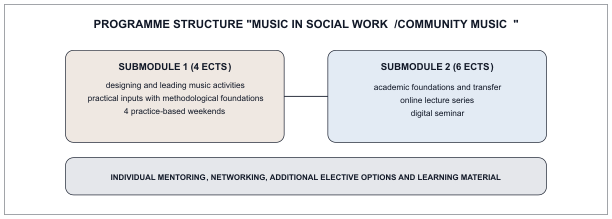
The cohort brings together different professional roles, which deliberately shapes the learning setting. The programme runs over roughly one year, awards 10 ECTS credits, and consists of two connected submodules that combine in-person phases with digitally supported elements. The first submodule focuses on practice-oriented group music-making in socially situated contexts. It uses intensive presence phases that foreground participatory music practices, facilitation, and reflection in relation to social diversity. Community music is a key reference point, particularly through the equal consideration of musical and social dimensions of practice. The second submodule supports practice transfer. A digitally supported lecture series with invited experts addresses the meanings and conditions of music in fields of social work. Building on this, participants develop a practice project in their own professional field and reflect on it in a structured way. Across both submodules, mentoring supports individual reflection (Peters & Ziegenmeyer, 2025, see Figure 1). This creates a learning setting in which differences in professional language and expectations become practically relevant. Translation is required in concrete teaching and learning situations, for example when musical and social aims intersect.
Boundary spanning becomes visible here as practical interface work between social work and music education. It is supported by multiprofessional teaching and unfolds in shared music-making and reflection where experiences and tensions can be addressed. Difference is not resolved, but remains present as a working condition of the programme.
The following section examines the transformation potentials emerging at micro and meso level.
In the programme Music in Social Work/Community Music, micro level transformation affects participants as well as those who design and facilitate the format. Peters and Ziegenmeyer (2025) describe academic continuing education as an incubator for transdisciplinary work because it links practice with structured reflection and supports the emergence of context sensitive knowledge. They also emphasise heterogeneity as an indispensable resource because diverse biographies can enable peer learning and perspective shifts. A key micro level transformation lies in how heterogeneity is actively worked with in teaching. Differences in educational and professional backgrounds are not treated as deficits, but as resources that need to be addressed explicitly in the learning design. Tensions between disciplinary logics are unavoidable and can become productive when they are identified and worked through in practice. This way, ambiguity tolerance emerges as a professional capability within the programme setting (Groß & Ziegenmeyer, 2025). Principles from social work such as openness and voluntariness in informal learning settings can conflict with more formal expectations that often shape music pedagogical practice in higher music education. Micro level transformation occurs when facilitators translate between these logics in practice and adjust the framing of the setting according to the group dynamics.
Community music plays a central role in this process because participatory music-making in socially situated contexts forms the practical core of the programme. Musical and social dimensions are treated as equally relevant, which opens a different way of thinking about aims and quality in a higher music education context (Groß & Ziegenmeyer, 2025). Even when artistic excellence is not the primary aim, questions of quality remain present in HMEI settings. In an article on the tensions between artistic excellence and social engagement in the context of HMEIs, Petri-Preis (2025) argues that artistic and societal aims should not be understood as opposing poles but rather as a continuum of possibilities. This resonates with the concept of "partnering of values" mentioned above (Gaunt et al., 2021, see section 1). Furthermore, Petri-Preis (2025, p. 11) draws on work that conceptualises musical excellence as plural musical virtuosities, including social forms of expertise while maintaining artistic relevance and advocates the term "expanded professionalism" in line with Westerlund and Gaunt. This perspective captures one of the programme’s key teaching concerns and helps frame what "quality" can mean in a way that fits the programme’s aims. Music understood as social practice provides a connecting core here, as meaning emerges through shared doing rather than through technical perfection alone. Excellence can be understood as the ability to shape musical and social processes with equal competence and to translate them into concrete situations (Petri-Preis, 2025). This makes boundary-spanning practice observable in this case example as ongoing translation within shared practice and reflection.
At the meso level, the programme creates a durable interface that brings people into the HMEI for whom higher music education has not traditionally been designed. Professionals from social work rarely enter music universities through degree programmes. Through academic continuing education, they enter as participants and as cooperation partners in teaching and programme development. This shifts who the MHL addresses and who feels invited.
In March 2025, a conference on music in social work, hosted by the MHL in cooperation with Nordkolleg, became a meso level nexus moment within the KMB.SH context. It brought together professionals from social work, music education, and regional partners in a shared space. Programme alumni contributed practice-based perspectives and helped translate between fields in public. This made the programme’s work more visible beyond the cohort and supported practices developed in the programme to travel into wider network settings. At the same time, the MHL emerged as a credible professional player in a field not traditionally associated with HMEIs and interest in the continuing education offer increased noticeably.
This opening feeds back into the institution. Perspectives and expertise from social work reshape how the purpose of music-making is discussed, including questions of social engagement and participation. The programme also stabilises partnerships within the KMB.SH and beyond, including the University of Applied Sciences Kiel and civil society actors. These collaborations extend the reach of the programme and support boundary-spanning practice across institutional fields. Music mediation practices thus contribute to a gradual reorientation of institutional self-understanding toward the Third Mission of higher music education, making an initial paradigm shift tangible.
Figure 2 synthesises the transformation pathway described above across macro framing conditions, meso level interfaces and micro level professional practice. It highlights boundary spanning as the connective work between these levels through translation, shared stance, and brokering.
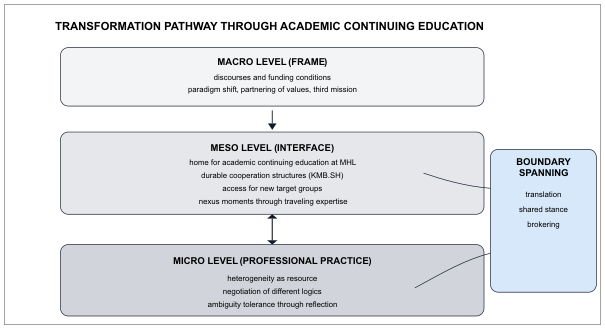
This theory-informed reflection on practice traced a transformation pathway in which KMB.SH-enabled academic continuing education made boundary-spanning music me diation practices observable. The analysis showed how change can emerge through sustained and often demanding translation across professional logics. The macro level functions primarily as a discourse and funding frame and not as an independent level of change.
The case exemplifies how institutional opening towards heterogeneous professions reshapes institutional learning inside a HMEI. In this setting, access shifts the questions that become discussable in the institution, including the purposes of music-making and the relationship between musical quality and social participation. Academic continuing education provides a specific interface for this opening because professionals can enter as participants, partners and, co-developers without the preconditions and gatekeeping logics of degree programmes. Building on Peters and Ziegenmeyer (2025), the case examined here supports the understanding of academic continuing education as an incubator for transdisciplinary work.
Transfer to other contexts depends on conditions. The most transferable aspect is the creation of structured points of entry for professionals from related fields, especially social work, combined with regional cooperation across institutional logics as exemplified by the KMB.SH consortium. Cooperation of this kind requires dedicated coordination capacity, recurring joint working routines and a shared stance that can hold differences without homogenising them. These requirements already indicate structural limits. The pathway is shaped by constraints and contextual dependencies. KMB.SH funding is limited in amount and time, even where long-term continuation is envisaged. Much of the consolidation depended on commitment beyond formal job descriptions and is hard to scale. Expanding academic continuing education within HMEIs faces formal hurdles, particularly those linked to financing and to visibility within institutional routines. Translation work across professional logics also requires organisational and emotional labour that rarely fits into institutional workload models. In such situations, individual actors can become critical. While leadership was not an explicit focus of the analysis, the case highlights its role both as an enabling condition and as a source of fragility. In this context, leadership took the form of facilitative and connective work that helped align actors, mediate across institutional contexts, and sustain the collaborative process. At the same time, the development relied heavily on one well-connected key actor who assumed a central leadership role. Sustaining such work requires resilience, as tensions remain present and translation work needs to be carried forward continuously. While supportive structures are essential, people are also needed who can engage with them flexibly without acting arbitrarily. Where capacity remains closely tied to individuals, structural stability remains vulnerable.
At the micro level, transformation becomes visible where heterogeneity is not smoothed, but actively worked with in practice and where questions of musical quality are negotiated in relation to social participation. At the meso level, the central potential lies in access and addressability. Academic continuing education brings professionals into the MHL for whom higher music education has not traditionally been designed, particularly from social work – and it establishes cooperation with partners inside the KMB.SH and beyond. This feeds back into the MHL by widening what counts as relevant expertise and by shifting how the purpose of music-making is discussed in relation to social engagement. In this sense, the case resonates with Gaunt et al.’s call for a paradigm shift in higher music education (2021, p. 16), even if the reach of this transformation pathway remains uneven. Currently, the developments traced here run partly alongside artistic degree contexts. Although interdisciplinary work is practised successfully to a certain extent at the MHL, socially engaged music mediation practice has not yet become part of artistic main subject teaching and is mainly developing within pedagogical degree programmes.
Looking ahead, academic continuing education at the MHL is expected to grow, with further offers in music mediation and related fields. It is also planned to become more strongly entangled with full time degree programmes, creating shared learning settings for students and professionals. This also opens a return route for alumni, linking lifelong learning with institutional development. A concrete next step is the forthcoming implementation of the module Artistic Citizenship within the polyvalent Bachelor of Arts programme Music Mediation. The module is open across study pathways, including options for professionals and emphasises project-oriented formats that engage heterogeneity and foster interdisciplinary collaboration. At the same time, project-based teaching is being expanded at institutional level within a broader, longer-term, externally funded teaching architecture initiative.3 In this context, the module may contribute to embedding boundary-spanning music mediation practices more firmly within degree structures. It remains to be seen how strongly these developments will be taken up within artistic degree programmes. In parallel, a community music network in Northern Germany is currently emerging, bringing together programme alumni and other interested practitioners from different professional fields. A "partnering of values" (Schmidt Campbell, 2016, as cited in Gaunt et al., 2021, p. 4) will not emerge from declarations. It depends on sustaining transformation pathways long enough to develop a lived institutional stance, where artistic and societal aims are no longer treated as competing agendas. Music mediation might not be the game changer here, but it can change how the game is played.
The manuscript was written in English using machine translation and digital writing tools and was subsequently thoroughly post-edited by the author. The schematic vector graphics were created with AI-assisted design tools and are based on models developed by the author, who retains full responsibility for the content of this article.
The partners are the University of Music Lübeck (MHL), Nordkolleg Rendsburg/Academy for Cultural Education, the Association of Music Schools (LVdM SH), the Music Council (LMR), and the Institute for Quality Development in Schools (IQSH).↩︎
In the Swiss model of academic continuing education, Certificates of Advanced Studies (CAS, at least 10 ECTS), Diplomas of Advanced Studies (DAS, at least 30 ECTS), and Master of Advanced Studies (MAS, at least 60 ECTS) form a modular certification structure (Zimmermann, 2019).↩︎
The teaching architecture initiative refers to the externally funded project MUZUG (Musikhochschule der Zukunft gestalten), supported by the Stiftung Innovation in der Hochschullehre.↩︎
Association Européenne des Conservatoires, Académies de Musique et Musikhochschulen (AEC). (2024). Lifelong learning survey report. Retrieved June 15, 2026, from https://aec-music.eu/news-article/lifelong-learning-survey-report/
Bishop, E. (2022). Künstlerische Musikstudiengänge: Zwischen Strukturwandel des klassischen Musikfelds und den Bologna-Reformen (Doctoral dissertation, Zeppelin Universität Friedrichshafen). ZUdoc. https://doi.org/10.48586/zu/11579
Bosch, M., & Ahner, P. (2025). Entwicklung innovativer Weiterbildungsformate an Musikhochschulen: Beispiele aus der Hochschulentwicklung im Kontext gesellschaftlicher und digitaler Transformation an der Hochschule für Musik Trossingen. In A. Hinsken, A.-M. Bodo-Hartmann, & J. Ehinger (Eds.), Qualität in der wissenschaftlichen und künstlerischen Weiterbildung: Akteur:innen, Organisationen, Gesellschaft (pp. 263–276). wbv. https://doi.org/10.3278/9783763978205
Gaunt, H., Duffy, C., Čorić, A., González Delgado, I. R., Messas, L., Pryimenko, O., & Sveidahl, H. (2021). Musicians as "makers in society": A conceptual foundation for contemporary professional higher music education. Frontiers in Psychology, 12, Article 713648. https://doi.org/10.3389/fpsyg.2021.713648
Groß, M., & Ziegenmeyer, A. (2025). Music as social practice: Interdisciplinary dialogue as a foundation for cultural participation in childhood and adolescence. Diskussion Musikpädagogik, 108, 3–8.
Hochschulrektorenkonferenz. (2021). Neue Möglichkeiten schaffen und nutzen: Empfehlungen zur wissenschaftlichen Weiterbildung [Recommendation adopted by the 32nd HRK General Assembly in Stuttgart]. Retrieved June 15, 2026, from https://www.hrk.de/fileadmin/redaktion/hrk/02-Dokumente/02-01-Beschluesse/2021-11-16_HRK-MV-Empfehlung_wissenschaftliche_Weiterbildung.pdf
International Journal of Music Mediation. (2025). Transformation. Music mediation as a game changer [Call for contributions]. Retrieved June 15, 2026, from https://ijmm.world/ijmm/call_for_contributions/4
Kompetenzzentrum für musikalische Bildung Schleswig-Holstein (KMB.SH). (n.d.). KMB.SH. Retrieved June 15, 2026, from https://www.kmb.sh/
Mohr, H. (2023). Zeit für Transformation(en): Notwendige Paradigmenwechsel in der Kulturpolitik. In S. Reiner, S. Sievers, & H. Mohr (Eds.), Systemkritik! Essays für eine Kulturpolitik der Transformation (pp. 23–28). transcript Verlag. https://doi.org/10.14361/9783839466551-003
Musikhochschule Lübeck. (n.d.). Weiterbildung. Retrieved June 15, 2026, from https://www.mh-luebeck.de/weiterbildung
Müller-Brozović, I. (2023). Das Konzert als Resonanzraum: Resonanzaffine Musikvermittlung durch intensives Erleben und Involviertsein. transcript Verlag.
Petri-Preis, A. (2025). Artistic excellence or social engagement? On the potential of artistic citizenship for tertiary music education. Diskussion Musikpädagogik, 108, pp. 9–15.
Petri-Preis, A., Chaker, S., & Ziegenmeyer, A. (2025). Doing music = doing society: The social-transformative potential of music mediation. In A. Petri-Preis & A. Ziegenmeyer (Eds.), Turning social: The social-transformative potential of music mediation (pp. 13–42). mdwPress. https://doi.org/10.14361/9783839425015
Peters, J., & Ziegenmeyer, A. (2025). Academic continuing education as an incubator for transdisciplinarity: The example of Schleswig-Holstein. Diskussion Musikpädagogik, 108, 47–54.
Smilde, R. (2021). Journeys of Lifelong Learning in Music: Perspectives on Musicians’ Identity and Professional Performance: a reflective handbook. Eburon Academic Publishers.
Stiftung Innovation in der Hochschullehre. (n.d.). MUZUG – Musikhochschule der Zukunft gestalten. Retrieved June 15, 2026, from https://stiftung-hochschullehre.de/projekt/muzug/
Wissenschaftsrat (2019). Empfehlungen zu hochschulischer Weiterbildung als Teil des lebenslangen Lernens (Drs. 7515-19). Retrieved June 15, 2026, from https://www.wissenschaftsrat.de/download/2019/7515-19.pdf
Westerlund, H., & Karttunen, S. (2025). Transforming higher music education: Systems learning through counter-stories of Finnish socially engaged musicians. In A. Petri-Preis & A. Ziegenmeyer (Eds.), Turning social: The social-transformative potential of music mediation (pp. 169–188). mdwPress. https://doi.org/10.14361/9783839425015
Zimmermann, T. E. (2019). Die Weiterbildungsformate CAS, DAS und MAS in der Schweizer Hochschullandschaft: Eine Betrachtung aus unterschiedlichen Blickwinkeln. Zeitschrift Hochschule und Weiterbildung, 2019(1), pp. 22–29. https://doi.org/10.25656/01:18307
Esther Anne Adrian has been Head of Academic Continuing Education at the Lübeck University of Music within the Schleswig-Holstein Competence Centre for Music Education (KMB.SH) since April 2024. Since March 2025, she has also been Acting Professor and interim Programme Director for the Master’s programme in Music Mediation and Music Management at the Detmold University of Music. From December 2022 to March 2024, she worked as Senior Content and Strategy Officer at the German Federal Association for Cultural Child and Youth Education (BKJ), focusing on digital transformation, sustainability and child protection in the context of cultural education. Until 2022, she was Deputy Head of the Education Department at the Elbphilharmonie Hamburg and served on the Steering Committee of the European Concert Hall Organisation (ECHO) as well as the international symposium The Art of Music Education.
The automated analysis of the work in order to obtain information, particularly concerning patterns, trends, and correlations as defined in § 44b (text and data mining) of the German Copyright Act (UrhG) is prohibited without the written consent of the rights holders
ISSN 2943-6109 – Volume 3/1 (2026) – DOI: 10.71228/ijmm.2026.52
This paper is published under a Creative Commons Attribution NonCommercial 4.0 International License. Parts of an article may be published under a different license. If this is the case, these parts are clearly marked as such.
