
The main focus of this paper is the Sound of Silence project, which aims to empower women through music mediation, providing them with a platform for self-expression regardless of prior musical experience. During multiple workshops, participants engaged in creative writing and composition exercises, focusing on self-reflection, emotional expression, active listening, and mutual care. Activities included storytelling, writing, voice improvisation, and instrumental play, fostering a safe space for creative exploration and collective agency. The project culminated in an intermedia installation featuring text projections, soundscapes, and interactive elements, allowing participants to share their work with the public. Visitors were encouraged to engage with the art and contribute their own thoughts. The project highlights the transformative potential of music mediation as a participatory process that decentralizes power dynamics and provides marginalized groups with opportunities for empowerment. By prioritizing collective creation and mutual exchange, Sound of Silence illustrates how participatory art can serve as a tool for social intervention and meaningful cultural transformation.
Im Mittelpunkt dieses Beitrags steht das Projekt Klang des Schweigens, das darauf abzielt, Frauen durch Musikvermittlung zu stärken und ihnen unabhängig von ihren musikalischen Vorerfahrungen eine Plattform für Selbstbestimmung und Ausdruck zu bieten. In mehreren Workshops setzten sich die Teilnehmerinnen mit kreativem Schreiben und kompositorischen Prozessen auseinander, wobei Selbstreflexion, emotionaler Ausdruck, aktives Zuhören und gegenseitige Fürsorge zentrale Rollen spielten. Zu den Aktivitäten gehörten biografisches Erzählen, Schreiben, Stimmimprovisation und instrumentales Musizieren, die einen geschützten Raum für kreative Erkundung und kollektive Agency eröffneten. Den Abschluss des Projekts bildete eine intermediale Installation mit Textprojektionen, Klanglandschaften und interaktiven Elementen, die es den Teilnehmerinnen ermöglichte, ihre Beiträge öffentlich zu präsentieren. Die Besucher:innen waren eingeladen, mit den künstlerischen Beiträgen in Dialog zu treten und eigene Gedanken einzubringen. Das Projekt verdeutlicht das transformative Potenzial von Musikvermittlung als partizipativem Prozess, der bestehende Machtdynamiken dezentriert und marginalisierten Gruppen Möglichkeiten zum Empowerment eröffnet. Indem Klang des Schweigens kollektive Gestaltung und wechselseitigen Austausch in den Mittelpunkt stellt, zeigt das Projekt, wie partizipative Kunst als Instrument sozialer Intervention und kulturellen Wandels wirksam werden kann.
Cet article se concentre sur l’analyse du projet Sound of Silence dont l’objectif est de développer le pouvoir d’agir de femmes grâce à la médiation de la musique en leur offrant une plateforme d’expression quelle que soit leur expérience musicale antérieure. Au fil de multiples ateliers, les participantes se sont engagées dans des activités d’écriture créative, de composition axées sur l’introspection, l’expression des émotions, l’écoute active et la bienveillance mutuelles. Les activités incluaient du storytelling, de l’écriture, de l’improvisation vocale, des interprétations instrumentales au sein d’un safe space propice à l’exploration créative et l’agentivité collective. Le climax du projet consistait en la présentation d’une installation artistique mêlant des projections de textes, des paysages sonores et des éléments interactifs permettant aux participant·es de partager leur travail avec le public. Les visiteurs étaient encouragés à interagir avec l’œuvre et contribuer en partager leurs propres pensées. Le projet met en lumière le pouvoir de transformation de la médiation de la musique comme processus participatif qui décentralise les dynamiques de pouvoir et offre aux groupes marginalisé une opportunité d’autonomisation. En mettant l’accent sur la création collective et l’échange mutuel Sound of Silence démontre comment l’art participatif peut servir comme outil d’intervention social et de transformation culturelle porteuse de sens.
empowerment, transformative experiences, collective agency, participatory art
I was born in Iran and only left the country when I was an adult. The political landscape and repressions, especially against women, influenced me deeply. In 2022 wide protest erupted in Iran sparked by the violent death of Jina Mahsa Amini, who was killed by the vice squad. The movement became known as “Woman, Life, Freedom”. Inspired by these protests and driven by a feeling of powerlessness and my personal involvement, I felt a strong need to give women a voice, to provide them with avenues for expression and a platform to be heard. I asked myself how such resistance could be expressed in an accessible and artistic way. Women have been marginalized in a manifold way and often reduced to means of silence. This silence can be a symptom of repression, but it can also be an expression of resistance. With the project Sound of Silence1 I wanted to give women a chance to unearth what their individual silence holds through artistic participation and personal expression.
This notion to focus the project on women was also supported by current political trends. In recent years, Western countries have witnessed a rise in support for right-wing agendas. Especially the societal view on women's rights and the integration of migrants have both suffered under these developments (Peral et al., 2024, pp. 3352–3353). Considering that musical institutions in Germany have been linked to a slow adaptation to diversify and include marginalized voices, music mediation offers a unique opportunity to foster self-representation and enable transformative processes for marginalized groups, thereby enabling empowerment through participatory practices (Gaupp, 2025, p. 106).
It is therefore essential to design music mediation projects in order to meet the needs of these groups, creating opportunities for productive participation in the arts sector. This conviction has been the main focus of the literary-compositional project Sound of Silence, which aims to provide a sustainable effort toward cultural diversity. The main focus of the project was to give women in marginalized positions an opportunity to participate in artistic endeavours regardless of prior musical knowledge and skills, and to provide them with a platform to express themselves intermedially and present their art to a public audience.
In the project, the participating women, through their artistic work, should not only be visible but also gain agency by engaging in the cultural sphere. Regardless of their social and ethnic backgrounds and religious beliefs or worldviews, the aim for every woman in the project was to participate freely and to engage with the aesthetic transformative experiences laid open in the project, in short, to feel empowered. This, in turn, enabled them to express themselves through various creative practices across a mix of literary-musical dimensions.
The group that participated in the project consisted of women who primarily directly or indirectly experienced migration, flight, and/or violence. Contact with the dialogue group was established through the cooperating institutions, namely Internationaler Frauentreff La Rosa [International Women's Group La Rosa] and Frauen-Treffpunkt Hannover [Women's Group Hanover]. However, some participants also became aware of the project through public relations efforts. Two employees from a women's drop-in and counseling center were also present at each workshop session to provide emotional support and professional care to the participants during and after the project if necessary. The team consisted of several workshop facilitators: an author, a composer, a director for the final stage production, and me as the project leader. The collaboration between the different actors that were involved was marked by an open feedback culture. A specific hallmark of the project was the active participation by the entire team as well as the external counselors from the women's groups. A total of 13 women from different countries of origin (e.g., Ukraine, Kazakhstan, Iran, Germany, Turkey, Palestine) participated in the project.
The project was originally designed for women in women's shelters. The managements of several women's shelters in Hanover were contacted and they welcomed the project in principle, however, it turned out that the protection concepts for these women did not allow them to participate in this project. Instead, participants were acquired through the women's groups where informational meetings with the project team were held.
A total of six three-hour-long workshops took place, focusing on joint creative and exploratory work. The participants' individual needs were taken into account throughout. For example, picture cards entitled “Mixed Feelings”2 were used, from which the women could choose one or two that matched their current state of mind. This facilitated both individual reflection and open, playful exchange about one's own emotions and, where applicable, vague “gut feelings”. This type of nonverbal check-in method was used at the beginning and end of a workshop, making emotional shifts recognizable and enabling new perspectives on one's own emotions as well as those of others.
The first workshop involved getting to know the workshop team and the participants. The women had the opportunity to experience both disciplines, writing and composing. Questions such as “What is sound?” and “What individual meanings do (certain) sounds have for you?” were discussed. In addition, there was an improvisational storytelling and writing exercise. The time frame and design of the project were intended to allow space for something often missing in music mediation projects: an atmosphere that enables a looking at, feeling towards, and openness to a covert Other, and thus supports a listening practice that gives every member of the dialogue group a voice (Haghighat, 2025, p. 74).
Listening played a vital part in the writing workshops. To elaborate on this, LaBelles excursion on the different directions of listening offers a theoretical grounding of how it was used as a strategy to empower oneself and other participants. Listening offers a way to transform thinking and the inner voice and make them tangible for a person to put into concrete words, turning the listening to oneself into something that can be ordered and written down (LaBelle, 2025, p. 16). He writes about the importance of listening:
It affects, as it is affected. I have been led to write about listening, feeling the pull of its deeply transformative influence, its patient and caring presence, which seems increasingly needed within today's environments marked by political violence and crisis. (LaBelle, 2025, p. 2)
Listening is therefore not only a passive process that is reduced to a mere wave of noise and voice rolling over the listener. As LaBelle defines it, it can be split into a set of activities that require individual action, thereby preventing the process from becoming a simple, passive construct. The act of “listening into” leads to an extended listening to oneself, which is marked by a “call out for attention, understanding, narrative, care,” and which is “aligned with epiphany, thoughtfulness, realization, and transformation” (LaBelle, 2025, pp. 16–17). The writing tasks used this concept to help participants listen to themselves and initiate a meaning-making process. It also helped to facilitate an ethic of care through “listening into” and “listening towards” others. By “listening into”, care for oneself is fostered through the screening of feelings and thoughts and therefore an acknowledgment for what arises from the inside. “Listening towards” shows care for others. It assures that others' presence is valued and in turn can update and inspire one's own thoughts and feelings on a given topic. Therefore in the writing exercises, listening elicited vital aspects of individual and shared experiences that could then be channeled into writing.
In two of the writing workshops, the women wrote short texts responding to different prompts. These prompts were kept simple, catering to the women's lives, like the origin of their given names. Examples of the prompted questions were: What does your name mean to you? Who gave you your name? Where does your name come from? Who uses your name and in what way? This way, they had a voluntary opportunity to share a personal story. To establish a reciprocal mode of caring, it was crucial to enable a dialogue in which participants could care for themselves by channeling their thoughts and feelings by the mode of “listening into”, or choose to care for others by “listening towards” them sharing their experiences. This caring and nurturing for each other within an interactive and collective setting formed the basis for a productive approach to music mediation.
One of the women began by sharing the origin of her Turkish name that was given to her despite her Kurdish heritage. Before she was born, her parents fled to Turkey. Her name was chosen to alleviate the struggles she might have faced because of her Kurdish heritage in her birthland. Another story shared by a participant concerned the expectation of a male child that influenced the process of giving her a name. After expecting their third-born child to be a son, for which they had prepared a male name, the reality of a female child then led to a delay in finding a suitable female name. This example shows how women can be affected by patriarchal structures regardless of culture and heritage.
This reality of the marginalization of women was also present in an exercise in which the women were asked to write about an item that had a special meaning for them. One woman wrote a story in Persian that she named “Our House” about her home and how she had to leave it behind to flee. She described the feelings connected to her experience: The hopelessness and uncertainty that lingered into the present and how much it pained her to leave her home, both the physical space and the concept of a homeland. In the following workshop, she read out her text aloud to the others while I translated it simultaneously for the group. The text resonated notably with the other women. Therefore the group decided to translate it into different languages and include it in the final intermedia presentation where it was projected onto one of the walls (cf. e.g. Fig 1).
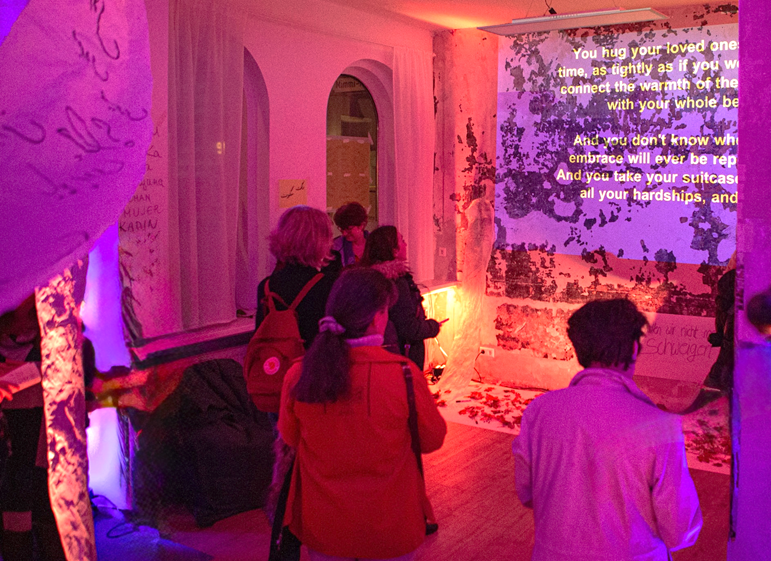
By “listening into” herself, the woman was able to sort her feelings into coherent text. The other participants acknowledged this by “listening towards” her, enabling a mode of safety for the group to share and at the same time sparking a process of “listening into” for everyone else that helped them connect the text to their own experiences. These joint accounts of implicit marginalization promoted a sense of collective agency among the participants that was only possible through the women-only format. Moreover, the format and the practice of listening gave room to a “transformative space of participatory art” where the unintelligibility, gaps, and contradictions of the lived experiences could be explored (Matarasso, 2019, p. 120).
It was important to me to not center or elicit the distressful events from the women's lives, but rather to focus on the agency they had in sharing information and stories that mattered to them. The women were from complex backgrounds but united by different experiences concerning marginalization, discrimination, flight, and migration. It would be naive to try to understand the experience of these women fully or to take their accounts and feelings as a mere representation of their different endeavours. It was furthermore not the point of the project to delineate accounts of trauma. However, it was vital to find a way to give the women a chance to express themselves without the restraints of the superimposed structures of power that the project team had simply by virtue of their societal status and academic background in the arts and music. This could only be achieved by an ethic of care that focuses on music mediation as a means of constructing and fostering relationships between the individuals, the dialogue group as a whole, and the public through the intermedia installation of the results of the workshop in the last phase of the project (Haghighat, 2025, p. 70).
A problem that often arises in the context of projects with a focus on music mediation is that an idea is imposed by project leads onto a set group. This might lead to a final product like a musical performance that seems polished on a surface level, however, the participatory aspect can be heavily neglected and participants are merely interchangeable objects of performance rather than truly participating and creating subjects with real agency. In Sound of Silence we tried to counteract this fallacy by the threefold strategies of holistic participation, freedom of outcome and “listening towards” each other and "into" oneself which can be subsumed under an ethic of care. The team and I were themselves participants in the project, whereby the structured hierarchy that can normally lead to a predetermined goal, like a specific piece of music, was dispersed by open expectations. An ethic of care was therefore implemented by design of the project. The writing and music-making led to unpredictable outcomes, by allowing everyone to listen and express themselves freely, and being supported rather than instructed. An ethic of care guided all participants, including the team, to truly listen and to foster individual and collective agency through creative practices.
Consequently, “listening into” and “towards” became a central focus of a writing activity titled “What's in My Bag?”. Participants were invited to imagine a bag they regularly carry and to list the items they would consider essential. After compiling their lists, they were asked to reflect on the connotations of these items and the symbolic meanings they might hold. The objects identified in this exercise proved to be a productive starting point for exploring specific female needs. Certain items, such as menstrual products or lipstick, prompted deeper biographical reflections, revealing diverse and personally significant dimensions of womanhood. The workshop then progressed to an exercise that opened a pathway toward listening both inwardly and relationally: listening to oneself, to others, and to music. As an initial step in introducing music mediation into the project, participants were invited to share their favorite songs, regardless of genre or artist. Selected excerpts of these songs were played for the group. The musical choices were notably diverse. Following the listening phase, participants described the associations and emotions evoked by the music. The task was intentionally designed to be simple and associative, in order to avoid reinforcing hierarchical dynamics between workshop facilitators and participants, particularly those arising from differing levels of familiarity with formal or scientific approaches to music.
Following up, the women were asked to conclude the first session by writing a text about their experience listening to their favorite songs. This necessitated ordering the inner chaos of feelings and the inner voice to extract the personal essence attached to the songs. Notable about this first session was the emotional atmosphere that the listening session at the end created for the participants. The women expressed contentment with the workshop's closed female space, which allowed them to lean into the creative exercises and share experiences important to them.
The first composition workshop focused on improvisational work. To begin, participants engaged in warm-up exercises using a variety of musical instruments alongside their own voices. These activities aimed to explore onomatopoetic voice play across different languages and instrumental sounds. Initially, the exercises centered on learning to use one’s own voice, feeling the resonance of the vocal cords while humming, and attending closely to the sound, pitch, and timbre of one’s voice.
The workshop then moved to more interactive exercises, involving the passing of sounds and tones around a circle to develop a shared sense of melody. Improvisational singing followed a call-and-response structure: One participant initiated a melody, and another responded either by elaborating on it or creating a new line. Body percussion was also incorporated, encouraging participants to experience rhythms and tonal patterns through their own bodies.
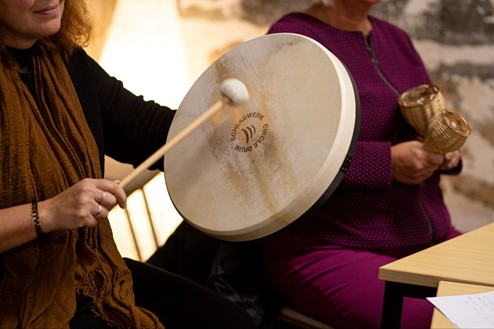
Following this very practical introduction to the workshop, participants were able to use various instruments such as frame drums, xylophones, vibra slaps, and wah-wah tubes. These instruments were specifically chosen because they offered easy access to instrumental play without major concerns for technique or the need for musical notes. One woman played the piano and wished for a keyboard instrument which was then provided for the workshops. Participants in general had little preexisting musical knowledge. As can be seen in Fig. 2 the women then tried to improvise and play a range of rhythmic patterns. These different modes of interaction and sound play presented a form of “participatory art” which Matarasso describes as “the creation of art by professional artists and non-professional artists” (2019, p. 48). This form of interplay between the different actors in the dialogue group gave all participants the chance to create something meaningful, and to let them experience the basic need of competency in a field that they had little to no experience with (Sagebiel & Pankofer, 2022, pp. 177–178).
The second composition workshop focused more on breathing techniques. The participants produced tones at different pitches, held them for variable durations, and varied their volume. Listening to the other participants again proved to be a vital aspect, as it had to be done actively to respond to the sound patterns of others and develop their own sounds that inspired them. To complement this, the women worked with the texts that they had created in the writing workshop. Single lines were isolated, and the sound of the words was used as musical source material that was interpreted in a variety of ways, like the singing of vowels in different pitches. Another exercise used improvisation with different words as a starting point to name other semantically related words in different languages.
The second part focused on improvising with the small instruments, occasionally mixing in whispered words, humming melodies, and other voice-driven sounds. Three different exercises were designed, each increasing the level of interaction. This was carried out in solo, duo, and trio improvisations with participants using different arrangements and group sizes and constellations to play with sounds. Based on this, the voice and instrumental extemporaneous forms were combined. The aspiration was to establish a feeling of contemplation and exploration with the produced sounds. Through the collective nature of the exercises, there was no assessment of what counted as music, contrariwise, everything should be perceived as music as only this discernment could lead to a collective feeling of competency that is needed to achieve the transformative space of participatory art. The transformative potential can be unlocked based on the individual feeling of being competent in what one is exercising. In participatory art, this notion also feeds on the collective agency, the group dynamic that no matter what is produced, one is actively contributing in expressing themselves and that alone is sufficient to create a collective piece of music or art.
As with every workshop, at the end the women had an opportunity to reflect on the tasks and give feedback. They also had room to share thoughts and feelings and reflect on how they felt during the workshop. One wish that the women expressed was to talk more about their favourite songs, to deepen the exchange of their individually connected experiences and feelings related to these songs. Some aspects that were reflected upon controversially was the breathing exercise or closing one's eyes that lead to discomfort for some women. The latter was especially helpful in planning further exercises and workshops since it sensitized the team to potential obstacles for a safe workshop environment. With the agreement of all participants, the improvised parts of the second workshop, both the read-out texts of the participants as well as their musical parts, were recorded without structure. The composer arranged these audio fragments into short audio loops, which were then used in the final sound installation.
During the meta-reflection of the process, I realized that I was under the fallacy of some music mediation projects. Sometimes, they fail to focus on participatory art as an open construct and instead sacrifice its rawness in favour of a specific agenda. This conduct is heavily influenced by other projects to create a vision that fits into this expectation of “real” art. At first, I was hesitant about the minimalist editing of the improvised and recorded segments. The composer only sorted the different segments with just tiny changes in the process of mixing and mastering. I felt like the audio arrangement was too “raw” and did not fit into my prescribed expectation of what the sound installation should present as a finished and polished artwork. However, during group discussion I was swayed and started to understand the composers vision was consistent with what we had envisioned as freedom of outcome in the first place. This view was mirrored by the women who participated in Sound of Silence who were delighted by the final installation that displayed their raw performance without much intrusion.
The Sound of Silence project ended on November 25, 2024, on the International Day for the Elimination of Violence against Women, with the final presentation taking place at the Autor:innenzentrum Hannover [Author's center Hanover]3. There was an array of different media forms accompanying the performance, including text fragments and video projections on the walls, permanent background sounds, lighting with different colors and varying intensities, and a participatory area for writing on the floor (cf. Fig 3).
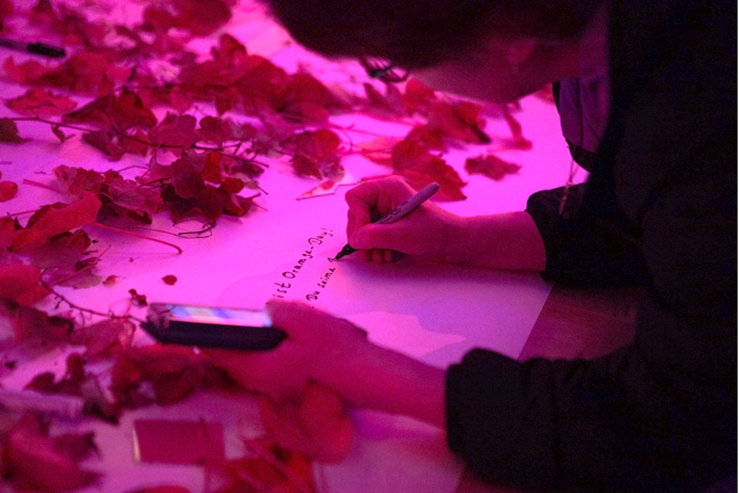
The audiovisual installation created a meeting place that connected people through their engagement with sounds and texts created by the participating women. However, sound was not the only focus; it was a supporting element. The space was transformed into a collage of text projections, music, lights, and dialogues. The installation marked a pivotal point in the project for the transformative potential of music mediation. The participating women had transformed their experiences in the workshop into snippets of sound, melodies, and pieces of writing, which, in turn, were transformed into the soundscape loops that formed the sound installation, spreading across the room mixed with other forms of visual media. The final design of the presentation was devised by the entire group. The women were free to explore their ideas about how the room was conceptualized, by selecting texts that they wanted to present and choosing fitting places for them. The position of the transducers was also decided collectively.
The presentation to the public defied the rigid expectation of publicly accessible art, where the project showed that this form of participatory transformative art is hard to define as it combines art as a learning experience, a collectively crafted piece of art, and art as a form of “social intervention” (Matarasso, 2019, p. 50). This intervention includes empowerment processes that can be achieved through participatory art and collective work, in which art decentralizes power relations between professional artists and perceived novices. This leads to a state in which both groups can reach a form of collective empowerment and agency (Sagebiel and Pankofer, 2022, p. 180).
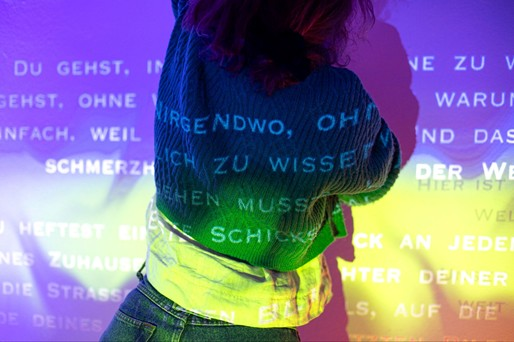
People were free to move around the room. The participants were also present. In order to protect them, they stayed anonymous throughout the presentation. A total of eight transducers were placed on various objects playing different composed loops, and there were also seats where visitors could sit and take in the intermedia design (cf. Fig. 4). Some engaged in conversation, while others listened to the sound installation on their own and immersed themselves in the women's words. Still others used the interactive area on the floor to express their own thoughts on the question “What do we not want to remain silent about?”. Terms such as femicide, assaults in public spaces, and injustice were noted. At the women's request, a text written by one of the participants was translated into four different languages and presented in a video projection. The participatory aspect reached beyond the workshop, into the sphere of the presentation, where the visitors were able to react by writing down their feelings and mingling with participants.
Music Mediation can take many shapes and forms. However, the entire project can be viewed as a participatory process of transformation for women who have been marginalized by society, in part due to patriarchal structures. This is why I pose that “listening towards” someone is just as important as being listened to in music mediation. Only through this ethic of care the transformational potential of music mediation can be unlocked. For this to be achieved, everyone involved needs to be considered as an equal participant whose creative and artistic output is valuable and a mutual effort is undertaken that refrains from becoming one-directional (Gaupp, 2025, p. 108).
In Sound of Silence I tried to open up the scope by enabling participants to explore their subjective experiences, thoughts, and memories through the freedom of expression and to transform them into different media forms through the process of participatory art. Instead of prescribing a victim role to the participants by eliciting recounts and accounts of marginalization in patriarchal societies, they were free to choose to be influenced in their artistic work by whatever they wanted to express. Dispersing the boundaries of team and participants by including everyone in the exercises and music making led to a transformative space where everyone could feel safe because of the practiced ethic of care.
An essential incentive of music mediation is to change the perception of professionals conveying their expertise about art to non-professionals. The process of music mediation should not be focused on shaping participants' musical efforts, but rather enabling them to shape their musical output themselves with an inherent openness for outcomes that do not necessarily fit into professional visions of music. To achieve this, the participating aspect of art creation needs to focus on meaningful exchange that is at least bidirectional and includes everyone in the process of learning, making art, and art discourse. This approach appears to be a promising redistribution of power in the cultural sector and can lead to a substantial transformation of music mediation projects and collective agency for its participants.
When considering this collective agency, I envision for the format to take on a more continuous form in order to be able to reach more women and increase sustainability in the long run. To achieve this, women who participated could eventually take on roles as facilitators acting as multipliers of the core concept of equal participation and creation. In the future, I hope for the women in shelters to be able to partake as well, since their position of marginalization prohibits them from participating in this sort of program while I contend that they would profit immensely from the opportunity to express their voices artistically.
The original project title in German was “Klang des Schweigens”. Attached is a trailer to give an impression of the project: https://www.youtube.com/watch?v=dGXd7zvm4ao (accessed April 25, 2026).↩︎
The cards were taken from: Follenius, B. (2021). Gemischte Gefühle: 56 Bildkarten für Therapie, Beratung und Coaching. Beltz.↩︎
The Autor:innenzentrum Hannover is a meeting place for people interested in writing who want to develop their writing skills and exchange ideas in free workshops and other education programs: https://hannoverschreibt.de (accessed April 25, 2026).↩︎
Follenius, B. (2021). Gemischte Gefühle: 56 Bildkarten für Therapie, Beratung und Coaching. Beltz.
Gaupp, L. (2025). Othering versus Empowerment: Decolonial Approaches in Music Mediation. In A. Petri-Preis & A. Ziegenmeyer (Eds.), Turning Social: The Social-Transformative Potential of Music Mediation (pp. 103–112). transcript.
Haghighat, L. (2025). Fürsorge. In S. Naqshband & T. Delille (Eds.), Art that Cares: Kunst(pädagogik) als kollektive Fürsorge (pp. 64–82). Unrast.
LaBelle, B. (2025). Poetics of Listening: Inner Life, Social Transformation, Planetary Practices. Bloomsbury Academic.
Matarasso, F. (2019). A Restless Art: How Participation Won and Why it Matters. Calouste Gulbenkian.
Multiphon. (2025, May 1). Klang des Schweigens | Sound of Silence. [Video]. YouTube. https://www.youtube.com/watch?v=dGXd7zvm4ao
Peral, E. B., Silvestre, M., & Kamatayeva, A. (2024). Value Change Regarding Gender Roles and Backlash in Europe: Is Gender a New´ Polarization Element? International Journal of Communication, 18, 3347–3367. https://ijoc.org/index.php/ijoc/article/view/21959/4690.
Sagebiel, J., & Pankofer, S. (2022). Soziale Arbeit und Machttheorien. Reflexionen und Handlungsansätze. Lambertus.
Nazfar Hadji studied instrumental pedagogy with a major in piano, as well as music research and music mediation, in Hanover. She is currently a research assistant in music education at the Institute for Music Education Research at the University of Music, Drama, and Media Hanover. Previously, she worked as a university assistant in instrumental and vocal pedagogy at the University of Music and Performing Arts Graz. Her research focuses on music education using ethnographic methods, diversity-sensitive music education, and transcultural artistic music mediation.
The automated analysis of the work in order to obtain information, particularly concerning patterns, trends, and correlations as defined in § 44b (text and data mining) of the German Copyright Act (UrhG) is prohibited without the written consent of the rights holders.
ISSN 2943-6109 – Volume 3/1 (2026) – DOI: 10.71228/ijmm.2026.51
This paper is published under a Creative Commons Attribution NonCommercial 4.0 International License. Parts of an article may be published under a different license. If this is the case, these parts are clearly marked as such.
